Darts Betting Guide
Darts Betting: The Complete Guide to Markets, Strategy and Value in 2026
 Available in US
- Why Darts Betting Is Booming — and How to Profit From It
- The Numbers, the Edge and the Framework in 90 Seconds
- How Darts Betting Works: From the Oche to the Sportsbook
- Darts Betting Markets: A Quick-Reference Overview
- Understanding Darts Odds and Finding Value
- Statistics That Drive Smart Darts Bets
- The PDC Landscape in 2026: Prize Money, Viewership and Growth
- The Littler Effect: How One Player Reshaped the Betting Market
- In-Play Darts Betting: Why Momentum Matters
- Darts Betting in Ireland: Regulation, Market Size and GRAI
- Your Pre-Bet Checklist: Seven Steps Before Every Wager
- Darts Betting Dos and Don’ts
- Darts Betting FAQ
Why Darts Betting Is Booming — and How to Profit From It
I placed my first darts bet in 2015, backing Adrian Lewis at 14/1 to win the World Matchplay. He lost in the second round. I lost forty quid. But somewhere between watching that match and obsessing over checkout percentages at three in the morning, I realised darts betting was unlike anything else I had encountered in a decade of sports analysis. The scoring is transparent, the data is granular, and the market inefficiencies — particularly in niche prop bets — are genuinely exploitable if you know where to look.
Fast forward to 2026, and the sport I fell in love with has exploded. Betting volumes on darts at Entain alone have surged 37% since 2018, with wagers on the PDC World Championship nearly doubling. Sky Sports recorded 51.2 million viewer hours for the World Championship this season — a figure that has more than doubled in four years. The money flowing into darts is reshaping odds, sharpening lines and attracting a new generation of punters who grew up watching Luke Littler highlights on YouTube rather than Phil Taylor on BBC Two.
Entain’s data shows a 92% increase in World Championship betting turnover and a 59% rise in total darts stakes since 2018 — making darts one of the fastest-growing betting sports in the UK and Ireland.
This guide is the resource I wish had existed when I started. Over eleven years of covering PDC tournaments, analysing betting markets and identifying value across European sportsbooks, I have developed a framework that consistently separates profitable darts bettors from the crowd. Everything in this guide is built on that framework: real data, tested strategies and lessons learned from thousands of bets — not recycled tipster clichés.
Darts is played on a standard board with 20 numbered segments, a bullseye and a double ring. The most common format is 501: each player starts at 501 points and works down to zero, finishing on a double. A “leg” is one game of 501. A “set” is a best-of-legs contest within a match. Most PDC events use legs-only formats, while the World Championship uses sets.
Whether you are placing your first ever darts bet from Dublin or refining an existing strategy, this guide covers markets, odds mechanics, statistical indicators, the 2026 PDC landscape, Irish regulatory context under GRAI, and a step-by-step pre-bet workflow. As Stella David, CEO of Entain, put it: the Littler Effect, rising stars and greater accessibility have “transformed darts into a global phenomenon” — and the sportsbook data proves it. Betting engagement mirrors the viewership surge, and the opportunity for informed punters has never been larger.
The Numbers, the Edge and the Framework in 90 Seconds
- Darts betting volume has surged 37% since 2018, with World Championship wagers nearly doubling — yet most punters still approach the sport without a data-driven framework.
- The PDC’s prize pool exceeds 25 million pounds in 2026. The World Championship alone offers 5 million pounds. More money in means sharper lines — and a greater premium on analytical discipline.
- Value identification starts with one formula: convert odds to implied probability, compare to your own estimate, and only bet when the gap exceeds 3 percentage points.
- Checkout percentage, not three-dart average, is the most undervalued stat in darts betting. It determines who wins close legs, and close legs determine close matches.
- Irish bettors now operate under GRAI regulation. Verify licence status, use deposit limits, and treat responsible gambling tools as essential infrastructure — not optional extras.
How Darts Betting Works: From the Oche to the Sportsbook
A friend of mine — a sharp football bettor — once told me he would never touch darts because “it’s just two blokes throwing pointy things at a board.” Six months later, after I walked him through the mechanics, he was building darts accumulators every Thursday during Premier League Darts. The learning curve is steep for about thirty minutes. After that, darts betting clicks in a way few other sports can match, because you can see every single data point in real time.
The foundation of professional darts is the 501 format. Both players begin with a score of 501 and aim to reduce it to exactly zero, with the final dart landing in a double segment or the bullseye. Each turn consists of three darts, and the maximum score per turn is 180 — triple twenty, triple twenty, triple twenty. The player who finishes first wins the leg.
Leg — a single game of 501. The basic unit of darts competition. Most PDC matches are decided as best-of-legs (e.g. best of 11 legs).
Set — a mini-match within a match. Each set is typically best of five legs. Sets are used at the World Championship, where early rounds are best of five sets and the final is best of thirteen.
Oche — the throwing line, positioned 7 feet 9.25 inches from the face of the board. Pronounced “ockey.”
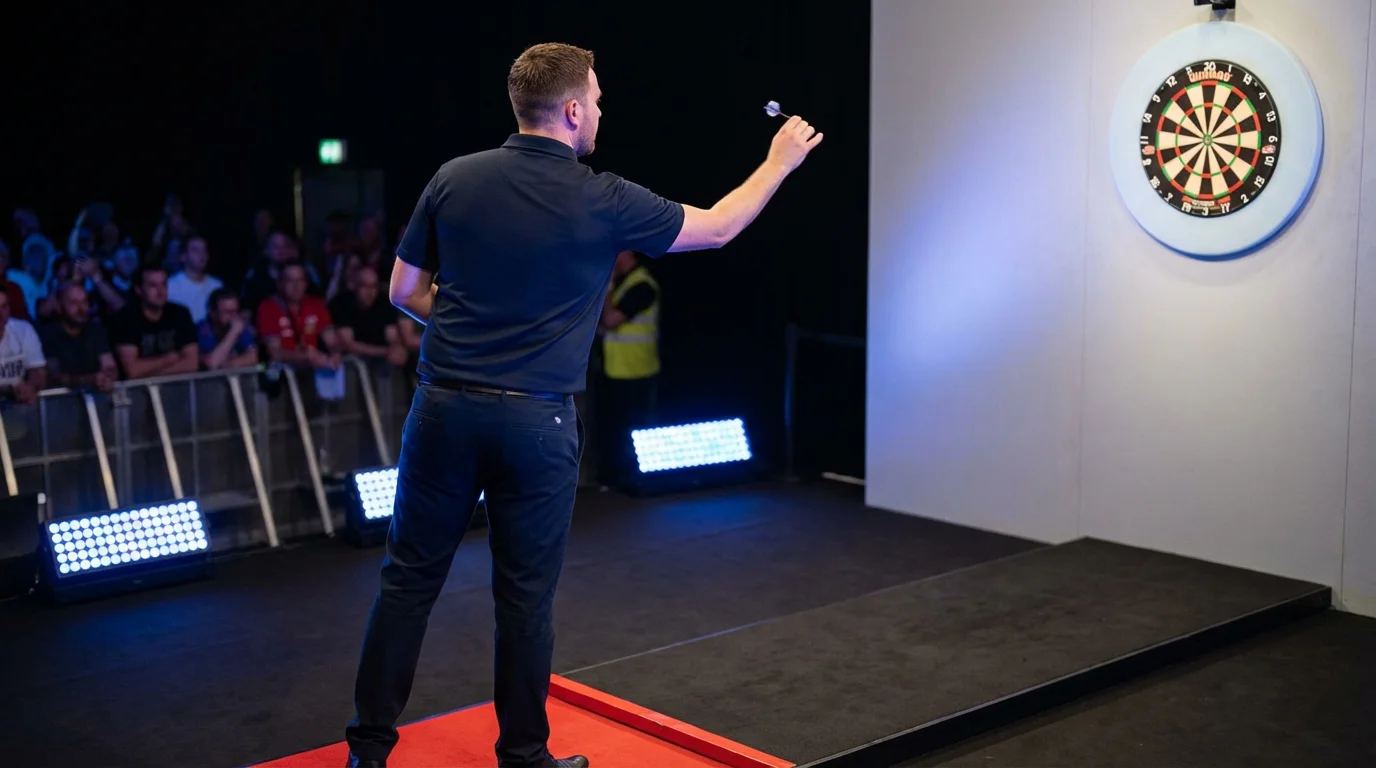
Double-out — the requirement to finish on a double segment. This means a player on 40 needs to hit double 20; a player on 32 needs double 16. The ability to “check out” under pressure separates elite players from the rest.
Here is why this matters for betting. The PDC has lifted its total prize pool to more than 25 million pounds in 2026 — a historic seven million pound increase over 2025. The World Championship alone doubled its prize fund to five million pounds, with the winner collecting one million. That level of prize money attracts elite performance, which in turn generates reliable statistical data. When I am assessing a match, I am working with three-dart averages, checkout percentages, 180 counts and head-to-head records that are publicly available and consistently tracked. Compare that to football, where expected goals models require proprietary data sets and still produce wildly different outputs depending on the provider.
How scoring works in practice: A player averaging 100 points per three-dart visit will typically need around 15 darts to win a leg of 501. Elite performers like Luke Littler, who regularly averages 105-115 in major matches, can close out legs in 12 darts. The fewer darts you need, the less chance your opponent has to respond — and the more predictable the match outcome becomes for bettors.
Sportsbooks price darts matches by assessing each player’s probability of winning individual legs, then modelling the overall match result across the required number of legs or sets. The pricing is driven by the same statistics you and I can access — which means the playing field between bookmaker and bettor is more level in darts than in almost any other sport. That accessibility is exactly what makes darts such a compelling betting medium, especially when you learn to identify which markets offer the widest edges.
One more thing to understand before we move on: the concept of “throw.” In each leg, one player throws first. Throwing first is an advantage — roughly equivalent to serving in tennis — because you get the first shot at building a lead. When a player wins a leg in which their opponent threw first, that is a “break of throw,” and it shifts the dynamics of the match significantly. Many in-play markets and correct score bets hinge on understanding this mechanic.
Darts Betting Markets: A Quick-Reference Overview
When I started covering darts for betting purposes, there were maybe three or four markets available per match. Today, a televised PDC semi-final might offer twenty-plus markets on a single sportsbook. The expansion has been driven by demand — and by the granular, real-time nature of darts data that makes exotic markets feasible to price.
Here is a quick-reference breakdown of the core markets you will encounter, along with a brief note on where each tends to offer the most interesting opportunities.
Match Winner
The simplest market: who wins the match. This is where most betting volume sits, and consequently where sportsbook margins are tightest. Odds are priced using each player’s recent form, head-to-head record and tournament context. Match winner is the foundation for accumulators and the first market most beginners should explore.
Outright / Tournament Winner
Betting on who will win the entire tournament, often weeks or months before it starts. Outright markets offer the highest potential returns but require patience and a strong read on field quality. The best value typically appears when lines first open and the market has not yet absorbed all available information.
Correct score involves predicting the exact scoreline — for example, 6-3 in a best-of-11 legs match. This market pays significantly better than match winner because you are narrowing the outcome space. I find correct score particularly interesting in sets-based formats, where the expanded structure creates more possible scorelines and therefore more opportunities for mispricing.
Handicap betting levels the playing field by giving one player a virtual head start in legs or sets. If a heavy favourite is priced at 1.10 to win outright, a -2.5 leg handicap on that favourite might offer odds around 1.85 — a far more interesting proposition if your analysis suggests the favourite will win comfortably. Handicaps are essential for finding value in lopsided matchups.
Match winner — implied probability example
Suppose Player A is offered at decimal odds of 1.50 and Player B at 2.80.
Player A implied probability: 1 / 1.50 = 66.7%
Player B implied probability: 1 / 2.80 = 35.7%
Combined: 102.4% — the 2.4% overround is the bookmaker’s margin. If your analysis suggests Player B’s true probability is closer to 42%, those odds of 2.80 represent a value bet.
180s markets let you bet on the total number of maximum scores in a match (over/under) or on individual player 180s totals. This is one of my favourite markets because 180s frequency correlates strongly with three-dart average but is also influenced by match length — a variable that most casual bettors underestimate.
Checkout and highest checkout markets focus on the finishing end of the game. You can bet on which player will hit the highest checkout in a match, or whether a 170 checkout — the maximum possible finish — will be achieved. Checkout percentage is arguably the most underrated stat in darts betting, and it drives results more directly than raw scoring power in tight matches.
Other markets worth knowing include break of throw (will either player lose a leg on their own throw?), nine-dart finish (the perfect leg — extremely rare, priced accordingly), and accumulator combinations that span multiple matches or markets within a single event.
Understanding Darts Odds and Finding Value
I have a rule that I tell every bettor who asks me for advice: if you cannot calculate implied probability in your head within five seconds, you are not ready to place a bet. That sounds harsh, but it is the single most important skill in darts betting — and it takes about ten minutes to learn.
Every set of odds represents a bookmaker’s estimate of an outcome’s probability, expressed as a price. Decimal odds of 2.00 imply a 50% chance. Odds of 4.00 imply 25%. The formula is straightforward: divide 1 by the decimal odds, multiply by 100, and you have the implied percentage. The question that separates profitable bettors from the rest is equally simple: do you believe the true probability is higher or lower than what the odds suggest?
Finding value: a real-world darts scenario
Step 1. A sportsbook offers Player A at 2.20 to win a quarter-final match. Implied probability: 1 / 2.20 = 45.5%.
Step 2. Your analysis — based on three-dart averages, checkout rates and head-to-head data — estimates Player A’s true win probability at 52%.
Step 3. Calculate expected value (EV). EV = (0.52 x 1.20) – (0.48 x 1.00) = 0.624 – 0.48 = +0.144. For every euro staked, you expect a long-term return of 14.4 cents.
Step 4. Any positive EV bet is a value bet. The margin here — 6.5 percentage points between implied and estimated probability — is substantial. In my experience, edges of 3-5% are worth taking in darts; anything above 5% is a strong play.

The worked example above is not hypothetical fluff. I run this calculation before every bet I place. The numbers change, the players change, the tournaments change — but the process does not. Darts is unusually suited to this approach because the key input variables (three-dart average, checkout percentage, recent form) are publicly available and updated in near real-time during PDC events.
Luke Littler, for instance, regularly posts three-dart averages of 105-115 in major matches during the current season. Top professionals typically sit in the 95-105 range. When Littler faces a player averaging 98 in recent floor events, I can model the leg-win probabilities with reasonable confidence and compare them to the bookmaker’s implied odds. If the sportsbook underestimates the performance gap — or overestimates it because of Littler’s public profile — value exists on one side or the other.
Closing line value is a concept borrowed from sharp sports betting: if the odds you locked in are better than the odds available at the start of the match, you likely had an edge. Over hundreds of bets, consistently beating the closing line is the strongest indicator of long-term profitability. Track your closing line performance religiously — it matters more than your short-term win rate. For a deeper dive into systematic approaches, see our data-driven betting strategy guide.
One trap I see constantly: bettors who chase “value” without doing the underlying analysis. Saying “those odds look too high” is not value identification — it is guessing with extra confidence. Value only exists when you have a defensible estimate of the true probability, built on data, and the bookmaker’s implied probability is meaningfully lower. Without that foundation, you are just gambling with a fancier vocabulary.
Statistics That Drive Smart Darts Bets
Three years ago, I spent an entire weekend building a spreadsheet that tracked every statistic I could find for the top 32 PDC players. Halfway through, I realised I was drowning in numbers that did not actually predict anything useful. The lesson was painful but valuable: not all darts statistics are created equal, and knowing which ones matter — and which ones mislead — is worth more than having access to all of them.
Three-dart average tiers in professional darts:
Below 90 — below tour standard. Players in this range rarely survive early rounds of major events.
90-95 — competent professional. Can win matches against lower-ranked opposition but vulnerable to form dips.
95-100 — strong tour player. Consistent enough to reach latter stages of ranking events.
100-105 — elite. This is where the top 16 in the world typically sit during televised events.
105+ — exceptional. Currently, only a handful of players sustain this level. Littler operates in the 105-115 range in majors.
Three-dart average is the headline stat, and for good reason: it measures raw scoring power across an entire match. A player averaging 100 will, on balance, beat a player averaging 92 far more often than not. But the stat has limitations that casual bettors tend to ignore. Averages fluctuate between events. A player who posted 104 in a televised quarter-final might average 94 on a cold Tuesday afternoon at a Players Championship floor event. Context matters as much as the number itself.
Checkout percentage is, in my view, the most underappreciated statistic in darts betting. It measures the percentage of attempts at a double that successfully finish a leg. A player with a high three-dart average but a low checkout rate will frequently build leads and then fail to close out legs — creating opportunities for opponents to steal breaks of throw. When I assess a match, I weight checkout percentage more heavily than most bettors do, because it directly determines who wins close legs, and close legs decide close matches.
Michael Smith holds the all-time record for most 180s in a single World Championship — 83, set in 2022. Despite that extraordinary scoring, Smith did not win the tournament that year. Raw 180s count alone does not predict match winners — it correlates with match length as much as with scoring dominance.
Head-to-head records offer useful context but require careful handling. A 7-2 career record between two players sounds decisive until you realise six of those matches were played three or more years ago, when both players were at different stages of their careers. I treat H2H data as a tiebreaker, not a primary input. Recent form, measured across the last eight to twelve competitive matches, tells me far more about what will happen tomorrow than a historical record that spans half a decade.
The statistics that consistently drive my betting decisions are, in order of importance: recent three-dart average (last 8-12 matches), checkout percentage in the same window, 180s per leg as a scoring intensity indicator, and head-to-head record filtered by recency and format. If you want to explore how each of these metrics works in practice — including where to find reliable live data during PDC events — our dedicated statistics guide breaks it all down.
Full checkout chart — every finish from 2 to 170
| Score | Recommended finish | Darts |
|---|
Value exists when your estimated win chance beats the book’s implied probability. As a rule of thumb on the Arrowline framework, an edge above 3 points is worth a bet; above 5 points is a strong play. This is a maths tool for your own estimate — not a prediction or tip.
The PDC Landscape in 2026: Prize Money, Viewership and Growth
If someone had told me in 2020 that darts prize money would double within six years and that the World Championship would offer a million pounds to the winner, I would have nodded politely and changed the subject. Yet here we are. The PDC’s transformation in 2026 is not incremental — it is a structural shift that has fundamentally changed how sportsbooks approach the sport and how bettors should think about their strategy.
PDC World Darts Championship 2026
Prize fund: 5,000,000 pounds (doubled from 2,500,000 in 2025)
Winner’s prize
1,000,000 pounds
Field size
128 players (expanded from 96) — the largest in World Championship history
Venue
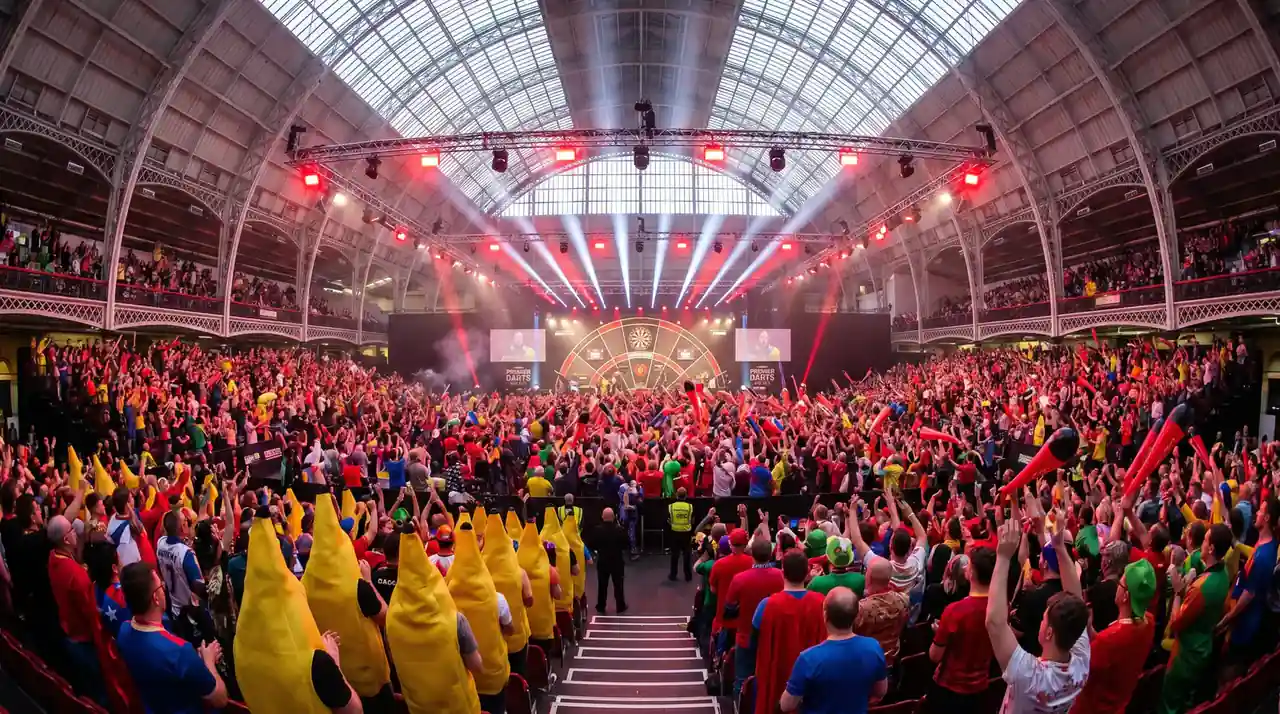
Alexandra Palace, London — moving to the Great Hall with capacity of approximately 5,000+ (up from 3,200 in the West Hall)
Format
Sets-based. Early rounds best of 5 sets, final best of 13 sets
The financial picture tells a story that every darts bettor needs to understand. The PDC’s total prize pool across all events now exceeds 25 million pounds — a seven million pound jump from 2025. The World Championship prize fund had sat at 2.5 million pounds for six consecutive years, from 2019 through 2025. Then it doubled overnight. That kind of sudden escalation does not happen in a vacuum. It happened because Sky Sports signed a new broadcast contract worth 25 million pounds per year — more than double the previous 12 million pound annual deal — and because the commercial ecosystem around darts is growing faster than almost any other sport in Europe.
Matt Porter, the PDC’s chief executive, has been clear about the ambition: “The one million pound prize for the World Champion reflects darts’ standing as one of the most exciting and in-demand sports in the world.” That statement is backed by hard numbers. Sky Sports logged 51.2 million viewer hours on the World Championship this season, and the overall viewership grew 13% year-on-year. The 2026 final between Littler and Van Veen peaked at 2.5 million viewers.
All 170,000 tickets for the World Championship were sold out in pre-sale, with 20% going to fans from outside the UK. Darts tourism is now a real phenomenon — and a signal of the sport’s expanding international footprint.
For bettors, this growth has two important consequences. First, more prize money attracts deeper fields and higher-quality performances, which makes statistical analysis more reliable. When a player is competing for life-changing sums, their motivation levels are consistent and their preparation is thorough — both of which reduce randomness in outcomes. Second, increased viewership and betting volume means sportsbooks are investing more resources in pricing darts accurately. The lazy lines that existed five years ago — where a sharp bettor could find edges of 8-10% on routine matches — are becoming rarer. You now need to work harder, specialise in specific markets, and act quickly when value appears.
The 2026 calendar extends well beyond the World Championship. Premier League Darts offers a 1.25 million pound prize pool with weekly knockout action. The European Tour finale in Dortmund drew a record 33,000 spectators. ITV broadcasts the Masters, UK Open, European Championship and Players Championship Finals under a deal running through 2028. Every one of these events represents a distinct betting opportunity with its own format, field composition and market characteristics — which is why understanding the full PDC calendar as a bettor’s roadmap is essential.
The Littler Effect: How One Player Reshaped the Betting Market
I remember watching Luke Littler’s run to the 2024 World Championship final as a seventeen-year-old and thinking: this changes everything. Not just for darts as a sport, but for darts as a betting market. I was right — but even I underestimated the scale of the transformation.
Littler is now an eighteen-year-old two-time world champion, having beaten Michael van Gerwen 7-3 in the 2025 final and then dismantling Gian van Veen 7-1 in 2026. He became only the fourth player in history to defend the title in consecutive years. His three-dart averages in major matches consistently sit in the 105-115 range — a level that only a handful of players in the sport’s history have sustained over a full season. He has a ten-year, 20 million pound equipment deal with Target Darts, the kind of commercial contract that was unimaginable in darts five years ago.
Littler’s sustained averages of 105-115 in major televised matches place him in a statistical tier that currently has no peer. For betting purposes, this means pricing models that rely on historical player data will systematically underestimate the gap between Littler and the field — unless the model explicitly accounts for his outlier-level performance.

The betting market implications are significant and specific. Before Littler, outright tournament favourite prices in major PDC events rarely dipped below 3.00 (decimal). Now, Littler is routinely priced at 1.80 or shorter for events like the World Championship and the Premier League. That compression squeezes value out of the obvious bets and pushes it into less trafficked markets — correct score, 180s props, handicaps and in-play opportunities where Littler’s dominance creates predictable patterns that sportsbooks have not yet fully absorbed.
The ripple effects extend beyond the oche. Matt Porter described Littler as someone who “opened up doors to a whole new audience and taken interest to a different level” — specifically a younger demographic that consumes the sport through social media first. A national survey found 35% of the UK population — more than 23 million people — have become more interested in darts over the past two years, making it the fastest-growing sport in Britain. The Junior Darts Corporation reports that academy waiting lists are now the norm; Steve Brown, the JDC chairman, says Littler’s impact on youth participation “has been amazing.”
For bettors, the Littler Effect creates a paradox. His dominance makes him the most logical outright pick in most tournaments — but the odds rarely offer value because the market has priced in his superiority. The profitable approach is not to avoid Littler entirely, nor to back him blindly, but to identify specific contexts where the market misprices him: early-round handicaps where his margin of victory is underestimated, 180s props in longer-format matches where his scoring power compounds, and — crucially — the rare occasions when a format or opponent matchup genuinely narrows his advantage.
In-Play Darts Betting: Why Momentum Matters
Picture this: a player wins the first two legs of a best-of-eleven match, both on throw. The sportsbook in-play odds swing dramatically in their favour. The crowd is behind them. The commentators are already talking about a comfortable victory. And then — a missed double, a break of throw, and suddenly the match is 2-2. I have seen this exact scenario play out hundreds of times, and it represents one of the most reliable in-play value opportunities in all of sports betting.
Darts is structurally built for in-play wagering. Each leg lasts roughly two to four minutes. Odds update after every leg. The data — who is throwing first, what averages they are posting, whether either player is struggling on doubles — is visible to anyone watching the match. There is no hidden information, no substitutions, no weather delays. What you see is what you get, and what you get changes every few minutes.
The momentum trap: In-play darts odds overreact to short-term momentum swings. A player who breaks throw to go 3-1 up will see their odds shorten sharply — but if their three-dart average is only marginally better than their opponent’s, the break may have been a statistical blip rather than a signal of dominance. The most profitable in-play bets I place are on players whose odds have drifted too far after losing a close leg on throw, when their underlying performance data suggests the drift is unjustified.
Three signals I watch between legs: first, three-dart averages for each player over the last three to four legs, not just the match average. A player whose recent legs show a rising trend is performing better than their overall average suggests. Second, checkout attempts versus checkout successes — a player who is hitting trebles consistently but missing doubles is likely to revert to their mean finishing rate, which means their current score may understate their true level. Third, body language at the oche. I know that sounds subjective, but after eleven years of watching professional darts, I can tell you that a player’s tempo between darts and their reaction to missed doubles is a genuine leading indicator of whether they are about to tilt or settle.
The key discipline with in-play darts betting is patience. The temptation to react to every leg result is enormous, especially when odds are moving rapidly. But the edge comes from waiting for the market to overreact and then stepping in with a position grounded in data, not adrenaline.
Darts Betting in Ireland: Regulation, Market Size and GRAI
I cover darts betting across European markets, and Ireland stands out — not because of its size, but because of the speed at which its regulatory landscape has changed. If you are betting from Ireland in 2026, you are operating under a fundamentally different framework than you were two years ago, and understanding that framework is not optional.
Ireland’s total gambling market is projected at 2.57 billion euros in 2025, with sports betting accounting for roughly 15% of that figure. Online sports betting specifically is forecast to reach approximately 365 million pounds by 2029. These are not trivial numbers, and they explain why the Irish government moved to create a dedicated regulatory body rather than continuing to rely on outdated licensing structures.
GRAI — Key facts:
The Gambling Regulatory Authority of Ireland was officially established on 5 March 2025 under the Gambling Regulation Act 2024.
Budget for 2025: 9.1 million euros.
Maximum penalties for operator violations: up to 20 million euros or 10% of annual turnover, whichever is greater.
Advertising watershed: gambling advertising is prohibited on TV and radio between 5:30 and 21:00.
Paul Quinn, the GRAI chairperson, described the commencement of the licensing function as providing “the statutory and legislative powers to regulate the gambling industry.” In practical terms, this means that any sportsbook operating in Ireland must hold a GRAI licence, comply with advertising restrictions, and implement responsible gambling tools including deposit limits, reality checks and self-exclusion mechanisms.
For darts bettors specifically, the GRAI framework has two direct implications. First, the advertising watershed means you will see fewer darts-related betting promotions during daytime broadcasts. The in-your-face free bet offers that used to saturate Sky Sports coverage before 9pm are no longer legal in Ireland. Second, the licensing requirements create a baseline of consumer protection that did not previously exist in a formalised way. If you are choosing a sportsbook for darts betting, verifying GRAI licence status should be the first step — not the fifth. Our guide to darts betting sites in Ireland covers what to check and what to prioritise.
Responsible gambling matters. Approximately 1 in 30 Irish adults experiences problem gambling — roughly ten times the rate recorded in 2019. Among Irish 16-year-olds, 22.9% reported gambling with money in the past year. If betting stops being enjoyable, or if you find yourself chasing losses, use the deposit limit and self-exclusion tools that GRAI-licensed operators are required to provide. Darts betting should be an informed, enjoyable activity — not a source of financial stress.
One aspect of the Irish market that I find encouraging: Irish bettors have a genuine cultural connection to darts. The atmosphere at Ally Pally regularly includes a vocal Irish contingent, and Irish-facing sportsbooks tend to offer competitive darts odds precisely because the demand is there. The regulatory clarity provided by GRAI should, over time, make the Irish market more attractive to operators — which means more competition, tighter margins and better odds for punters.
Your Pre-Bet Checklist: Seven Steps Before Every Wager
Every bet I place goes through the same seven-step process. It took me years to formalise it, and I still catch myself occasionally trying to skip steps when I think I “already know” the answer. Spoiler: skipping steps is how I lost money on a seemingly obvious Gerwyn Price bet in 2023 that a two-minute form check would have flagged as dangerous.
This checklist is not theoretical. It is the exact workflow I use before committing money to a darts bet, whether it is a five-euro punt on Premier League night or a fifty-euro position on a World Championship outright.
Seven steps before every darts wager
- Check recent form across the last 8-12 competitive matches. Do not rely on the last televised event alone. Floor event results — Players Championship days, European Tour qualifiers — reveal a player’s true current level far better than a single high-profile match. Look for trends: is the three-dart average rising, falling or flat?
- Review head-to-head records, filtered by recency. A career H2H of 8-3 means less than you think if the last four meetings are 2-2. Focus on the past two years and on matches played in a similar format (legs or sets) to the one you are betting on.
- Analyse the format. Is it legs-only or sets-based? Short formats (best of 7, best of 9 legs) increase variance and favour underdogs. Long formats (best of 11+ legs, or sets at the Worlds) compress variance and reward consistency. Your bet selection should reflect this.
- Calculate implied probability from the offered odds. Use the formula: 1 / decimal odds = implied probability. Compare this to your own assessment. If the gap is less than 3%, the edge is likely too thin to justify the bet.
- Compare odds across at least three sportsbooks. Darts odds vary more between operators than most bettors realise, especially in prop markets. A five-minute comparison can improve your effective odds by 5-10% on the same selection.
- Set your stake using a consistent unit system. I recommend flat staking at 1-3% of your total bankroll per bet. If the edge is larger, the upper end of that range is justified. Never exceed 5% on a single selection, regardless of how confident you feel.
- Record the bet. Date, event, market, selection, odds, stake, reasoning. Review weekly. This sounds tedious, and it is — but it is also the single practice that most consistently separates long-term winners from long-term losers. If you are not tracking, you are guessing about your own performance.
The most important step is also the most frequently skipped: recording the bet with your reasoning. When I review my betting log at the end of each month, the bets that went wrong are almost always the ones where my recorded reasoning was weakest — vague, emotional or based on a single data point rather than a converging set of indicators. The log forces honesty in real time, which is the cheapest and most effective edge you can give yourself.
Darts Betting Dos and Don’ts
The checklist above gives you a process. What follows is something different: a set of behavioural principles that I have seen separate consistent winners from consistent losers over more than a decade. Some of these I learned the hard way.
Do
- Specialise in two or three markets rather than spreading thin across everything available. Deep knowledge of correct score and 180s markets, for example, creates a bigger edge than shallow familiarity with twelve different bet types.
- Use floor event results as your primary form indicator. Pro Tour days are where players compete without cameras and crowds — the data is purer and less influenced by the “big stage” variable.
- Compare odds across multiple sportsbooks before every bet. It takes minutes and consistently improves returns.
- Review your betting log monthly and adjust based on what the data tells you, not what your ego prefers. The patterns that emerge from a hundred tracked bets are worth more than any single tipster’s advice.
- Understand the format before you bet. A player who thrives in short-leg shootouts may be a poor pick in a sets-based World Championship match. Format awareness alone puts you ahead of most recreational bettors.
- Set a bankroll and stick to a flat staking plan. The maths is clear: consistent unit sizing protects you during losing streaks and compounds gains during winning ones.
Don’t
- Chase losses with impulsive in-play bets. The in-play market is where discipline goes to die. If your pre-match bet lost, the answer is almost never “double down live.”
- Overweight big names and past champions. Darts form is volatile. A player who won a major six months ago may be averaging 93 on the current floor circuit. Check the data, not the reputation.
- Ignore checkout percentage. A player hitting trebles consistently but missing doubles is a ticking time bomb in close matches. This stat is underpriced by the market more often than any other.
- Bet on every event. The PDC calendar is packed. Not every tournament offers value, and forcing bets on thin-edge situations erodes your bankroll over time. Selectivity is a strategy, not a weakness.
- Rely on a single statistic. Three-dart average matters, but it is one input among several. Players with identical averages can have radically different checkout rates, 180s frequencies and head-to-head dynamics.
- Assume the favourite always wins in darts. Short-format matches produce upsets at a higher rate than most bettors expect. The oche is a great equaliser in best-of-seven-leg contests.
Darts Betting FAQ
How does darts betting work?
Darts betting works like most sports betting: you select an outcome, place a stake at offered odds, and receive a payout if your selection wins. The most common market is match winner. Sportsbooks set odds based on recent form, historical performance and head-to-head records. Beyond match winner, darts offers correct score, handicaps, 180s totals, checkout specials and outright tournament winner bets. The sport’s transparent, data-rich nature means you can assess probabilities using publicly available statistics — three-dart averages, checkout percentages and 180s counts — rather than relying on proprietary models.
What are the most popular darts betting markets?
Match winner is the most heavily traded market, followed by outright tournament winner for major PDC events. Correct score betting — predicting the exact scoreline in legs or sets — is popular among experienced bettors because it offers higher odds for more precise predictions. Handicap betting attracts significant volume when matchups are lopsided, as it allows bettors to find value on heavy favourites or underdogs. 180s markets (over/under on maximum scores) have grown rapidly in popularity because they are easy to understand and add excitement throughout a match. Checkout-related markets and break of throw bets round out the main offerings on most major sportsbooks.
How do I find value in darts odds?
Finding value requires comparing the bookmaker’s implied probability to your own estimated probability for an outcome. Convert decimal odds to implied probability using the formula: 1 divided by the decimal odds. Then build your own estimate using recent three-dart averages, checkout percentages, head-to-head records and format context. If your estimated probability is meaningfully higher than the implied probability — I look for a gap of at least 3 percentage points — you have identified a potential value bet. Consistently beating the closing line (the odds available at match start) over a sample of 100+ bets is the strongest evidence that your value identification process is working.
Is in-play betting available for darts?
Yes, and darts is one of the best sports for in-play betting. Legs last just two to four minutes, so odds update frequently and the data driving those updates — scoring averages, checkout success, breaks of throw — is visible to anyone watching the match. Most major sportsbooks offer in-play markets on televised PDC events, including match winner, next leg winner, total legs and various prop bets. The key advantage of darts in-play betting is transparency: there is no hidden information. The challenge is discipline — in-play odds overreact to short-term momentum, and the most profitable approach involves patience and data analysis rather than reactive betting.
What statistics matter most for darts betting?
The four most predictive statistics are recent three-dart average (measured over the last 8-12 competitive matches), checkout percentage, 180s per leg and head-to-head record filtered by recency and format. Three-dart average captures overall scoring power. Checkout percentage reveals finishing ability under pressure — the stat most undervalued by casual bettors. 180s frequency indicates scoring explosiveness. Head-to-head records offer context but should be weighted toward recent encounters. With the Irish online sports betting market projected to approach 365 million pounds by 2029, the audience and analytical tools for darts betting continue to expand.
What PDC tournaments are best for betting?
The World Championship offers the deepest markets and the most extensive statistical coverage, making it the easiest tournament to analyse thoroughly. Premier League Darts provides weekly betting opportunities with a small, elite field — ideal for bettors who want to specialise. The World Matchplay and UK Open use legs-only formats that increase variance, creating more underdog value. The World Grand Prix, with its unique double-start requirement, produces the most pricing inefficiencies because the format is unfamiliar to many bettors and sportsbook models. European Tour events and Players Championship floor days offer thinner markets but genuine edges for bettors willing to research lower-profile matchups.
Is darts betting legal in Ireland?
Yes, darts betting is fully legal in Ireland. The Gambling Regulatory Authority of Ireland, established in March 2025 under the Gambling Regulation Act 2024, now oversees all licensed gambling activity in the country. Operators must hold a GRAI licence to offer betting services to Irish customers. The regulatory framework includes consumer protections such as mandatory deposit limits, self-exclusion tools and an advertising watershed that prohibits gambling advertising on TV and radio between 5:30 and 21:00. Bettors must be at least 18 years old. If you want to verify whether a specific sportsbook is licensed, the GRAI maintains a public register of authorised operators.
Created by the ”Darts Betting” editorial team.